
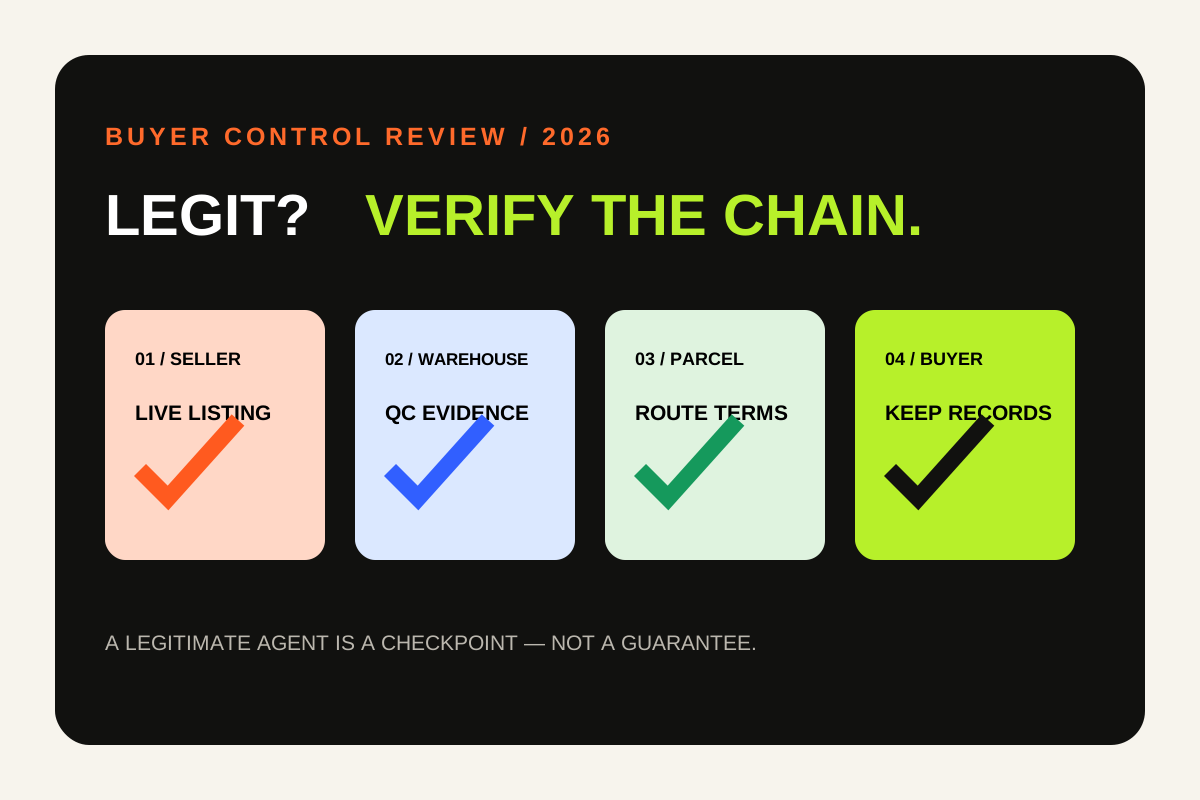
Sugargoo is a functioning China purchasing-agent platform, but “legit” and “safe” are not the same question. A legitimate service can still involve a poor marketplace seller, a misunderstood product option, an expensive parcel or a customs delay. The useful review is therefore not a single yes-or-no verdict. It is a map of who controls each step, what evidence exists and when the buyer can still correct a mistake.
This guide evaluates Sugargoo as a workflow rather than treating every successful or unsuccessful haul as proof of the entire platform. Sugargoo’s public service materials describe the core agent process: a buyer submits a product link or order, the purchasing team buys from a China-based seller, the warehouse receives and photographs the item, and the buyer later submits approved goods for international delivery. That is a real and understandable service model. Safety depends on using its checkpoints carefully.
What “legit” should mean in this review
For an online buying agent, legitimacy means more than having a polished home page. A buyer should be able to identify the official domain, create an account, produce an order record, see status changes, receive warehouse evidence, submit an after-sales request and obtain a parcel tracking record. The platform should distinguish product payments from international freight and show the buyer what action is required at each stage.
Sugargoo provides those recognizable agent functions. Its official materials discuss supported marketplace links, purchasing, warehouse inspection, storage, consolidation, shipping estimates and parcel tracking. This does not certify every seller or every route. It shows that the platform has an operational structure a buyer can document. A scam judgment based only on one delayed seller or one carrier incident confuses separate parties in the transaction.
Understand the four different risk layers
The first layer is the marketplace seller. A seller controls stock, variant accuracy, domestic dispatch and much of the product quality. The second layer is the purchasing agent, which submits the order, communicates changes and creates a warehouse record. The third is the international carrier and customs chain. The fourth is the buyer’s own instructions: the chosen SKU, address, declaration information, timing and decision to approve or return an item.
Separating these layers makes support requests more precise. A wrong color visible at the warehouse is primarily a product-order problem. A parcel that has not moved after export is a shipping investigation. A payment amount that differs from the selected method requires a checkout record. Calling every problem “Sugargoo is unsafe” hides the evidence needed to solve it; assuming the agent guarantees all four layers is equally unhelpful.
Verify that you are using the official service
Begin with the exact domain and a password that is not reused elsewhere. Reach the account from a saved bookmark rather than an unsolicited message. Treat social-media helpers, spreadsheet curators and community moderators as separate parties unless the official platform identifies them. Never give a login code or payment credential to someone who claims that a parcel can be released through a private transfer.
At checkout, record the order number, selected payment method, charged currency and final amount. Currency conversion and processor fees can make the card statement differ from the product subtotal, so compare complete totals rather than isolated rates. Keep the confirmation screen and later refund entries together. A coherent ledger is stronger evidence than a collection of cropped payment screenshots without order identifiers.
Product discovery is not product verification
A Sugargoo spreadsheet, seller photograph or community recommendation can help find an item, but it cannot preserve a live marketplace page. Before payment, open the current source listing and confirm seller, product, color, size, version, bundle, quantity, price and domestic freight. Write the intended combination in one sentence. If the lowest displayed price belongs to an accessory or deposit, do not assume it buys the hero product.
Save the source URL and the selected options. If the agent later reports a price change, substitution or stock problem, compare the new proposal with that record. Approving a substitute is a new buying decision. A vague instruction such as “black large best version” leaves too much room for interpretation; a specific seller label, thumbnail and measurement makes the purchase auditable.
Use warehouse QC as evidence, not a quality certificate
Sugargoo’s warehouse inspection and photo stage is one of the most important buyer controls. Use it first to test order accuracy: model, visible color, size label, quantity and included components. Then review obvious condition, alignment, surface marks, seams, hardware and packaging damage. Compare both sides of paired items and request a measurement when fit depends on a number rather than a printed size.
QC photos have limits. They do not prove fabric feel, internal construction, battery health, long-term durability, waterproofing or authenticity. Lighting can alter color, and a wide image can hide a detail that matters. Ask a narrow question while the item is still in the warehouse: for example, request the inside label beside a ruler or a close view of a damaged corner. “More photos” is less useful than a defined evidence gap.
Returns are safest before international shipping
If warehouse evidence shows the wrong item, a visible defect or a material difference from the order, keep it out of the parcel. Open the appropriate after-sales request promptly and attach the source record, order selection and warehouse evidence. Seller return acceptance, China-side shipping and timing can vary. The practical advantage is not a universal refund guarantee; it is the opportunity to resolve an error before overseas freight makes correction slower or uneconomic.
Distinguish a seller fault from a change of mind. If the delivered unit matches the selected option but the buyer no longer wants it, the available remedy may differ. Ask for one clear outcome—return, exchange, missing component or further inspection—and track its status until the balance or replacement is visible. Do not assume an approved request is complete merely because a support message sounds positive.
Shipping safety starts before parcel submission
A product can be safe to purchase but difficult to ship. Batteries, liquids, cosmetics, food, magnets, oversized goods and certain branded products may have route restrictions. Check current eligibility before building a haul around one line. Route availability is destination- and product-dependent, and a route visible for another buyer is not proof that it will accept your parcel.
Confirm the recipient name, address format, postcode and telephone number. Review the selected inventory, packed weight, dimensions, packaging services, route terms, tracking level and any protection option. Save the final parcel summary. Customs decisions and carrier delays remain outside any agent’s complete control, so promises of guaranteed clearance, tax-free delivery or exact arrival should be treated cautiously.
How to read reviews without being misled
Useful reviews identify the date, destination, product type, parcel weight, route and the stage at which a problem occurred. A five-star comment that says only “fast” provides little forecasting value. A negative review can be informative when it shows a timeline and evidence, but not when it merges seller dispatch, warehouse handling, export scanning and last-mile delivery into one unexplained delay.
Prioritize recent patterns over isolated extremes. Agent interfaces, payment methods, routes and policies change. Compare experiences that resemble your own destination and parcel. Look for how support handled documented issues, not merely whether a buyer liked the item. Product satisfaction is mostly a seller outcome; process transparency and correction handling are better measures of the agent.
A low-risk first-order test
Start with one or two inexpensive, non-urgent items whose variants are easy to describe. Avoid restricted categories and fragile collectibles. Record the listing, place the order, watch the status changes, inspect the warehouse evidence, test any return question while time remains, and compare preliminary freight with the measured parcel. The purpose is to learn the whole chain at a tolerable cost.
Keep a simple control sheet with order number, seller link, exact SKU, amount paid, warehouse arrival, QC decision, parcel number and tracking outcome. This makes a second order safer because you are improving a repeatable process instead of relying on memory. Increase value only after the platform, payment method and destination route have behaved as expected for you.
Warning signs that should stop the transaction
Pause if the domain is unfamiliar, a contact requests credentials, payment must move to an unverified private channel, the order summary does not match the selected SKU, or a seller change is presented without enough detail. Also pause when the route excludes the item type, the recipient information is incomplete, or the parcel contains an unresolved warehouse dispute. Urgency is not a reason to remove evidence.
Avoid anyone promising guaranteed authenticity, guaranteed customs clearance or a fixed delivery day for an international parcel. A responsible agent workflow can reduce uncertainty, not eliminate it. If a transaction cannot be described through an official order and parcel record, the safest response is to stop and verify through official support.
Verdict: legitimate service, conditional safety
Sugargoo is a legitimate purchasing-agent service in the practical sense that it operates an order, warehouse, inspection and forwarding workflow. It can make buying from Chinese marketplaces more controlled than dealing with an unknown seller without a receiving checkpoint. It is not a guarantee that every listing is accurate, every item is high quality or every parcel will clear and arrive on schedule.
The safest conclusion is conditional: use the official domain, preserve the exact order, judge only what QC evidence can show, resolve errors in China, compare eligible shipping routes and keep complete records. Buyers who treat the agent as a system of checkpoints have more control than buyers who treat it as a seal of approval.
Frequently asked questions
Is Sugargoo a real company or a scam?
Sugargoo operates a purchasing-agent service with an ordering platform, warehouse workflow, quality-control photos and international parcel tools. That makes it a real service, but it does not remove seller, product, customs or carrier risk.
Does Sugargoo sell the products itself?
Usually no. The agent purchases from third-party Chinese marketplace sellers on the buyer’s instructions, receives the goods and forwards approved items. Product quality and seller accuracy remain separate from the agent’s platform operation.
Are Sugargoo QC photos a guarantee of quality?
No. They are useful evidence of visible condition and order accuracy, but cannot prove hidden construction, long-term durability, material feel, electronics reliability or authenticity.
Can I get a refund if an item is wrong?
An after-sales request may be possible while the item is still in China, subject to the seller’s rules, timing and evidence. Record the mismatch clearly and act before international parcel submission.
Is payment on Sugargoo completely risk free?
No online or cross-border payment is completely risk free. Confirm the domain, account total, currency conversion and payment record, and never send funds through an unverified contact or off-platform request.
What is the safest first Sugargoo order?
Use a small, non-urgent order with an unambiguous variant and a product type accepted by several shipping routes. Learn the complete workflow before committing a large or time-sensitive haul.